Affordable but Stable Hosting for Small Businesses: What Actually Matters
For small businesses, choosing web hosting is not about finding the cheapest option. It is about finding hosting that is affordable, stable, and reliable enough to support business operations without constant downtime or hidden costs.
Many small business websites fail not because of bad design or weak content, but because of poor hosting decisions. This article explains what “cheap but stable hosting” really means, what to avoid, and how small businesses should choose hosting intelligently.
Why Hosting Stability Is Critical for Small Businesses
A small business website is not just an online brochure. It is often:
A sales channel
A customer support touchpoint
A credibility signal
When hosting is unstable, the consequences are real:
Lost sales from downtime
Lower Google rankings due to poor uptime
Reduced trust from potential customers
Cheap hosting that frequently goes offline is not affordable in the long run.
What “Cheap Hosting” Really Means (And What It Doesn’t)
Affordable hosting does not mean the lowest price on the market.
Cheap hosting should mean:
Predictable monthly or yearly costs
No surprise renewal fees
Resources sufficient for small business traffic
Cheap hosting does NOT mean:
Unlimited features with no explanation
Overcrowded servers
Zero customer support
If a hosting provider promises everything for almost nothing, stability is usually the first thing sacrificed.
Key Features Small Businesses Must Prioritize
1. Uptime Reliability
For business websites, uptime below 99.9% is a warning sign. Even small outages can affect revenue and reputation.
Look for:
Clear uptime guarantees
Transparent server status reporting
Avoid providers that are vague about uptime performance.
2. Server Performance (Not Just Storage)
Many hosting plans advertise large storage but hide poor performance.
Performance depends on:
Server load
CPU and memory allocation
Quality of infrastructure
For small business sites, consistent performance matters more than large disk space.
3. Scalability
A small business today may not be small tomorrow.
Good hosting should allow:
Easy upgrades
Migration to higher plans without downtime
Flexible resource scaling
Hosting that locks you into one rigid plan becomes a bottleneck as your business grows.
4. Security Basics
Cheap hosting without security is a liability.
Minimum requirements:
SSL support
Malware protection
Regular backups
Security incidents cost more than hosting upgrades.
5. Real Customer Support
When something breaks, documentation alone is not enough.
Reliable hosting includes:
Responsive technical support
Clear communication during incidents
Support that understands business use cases
Slow or scripted support is a hidden cost.
Shared Hosting vs VPS for Small Businesses
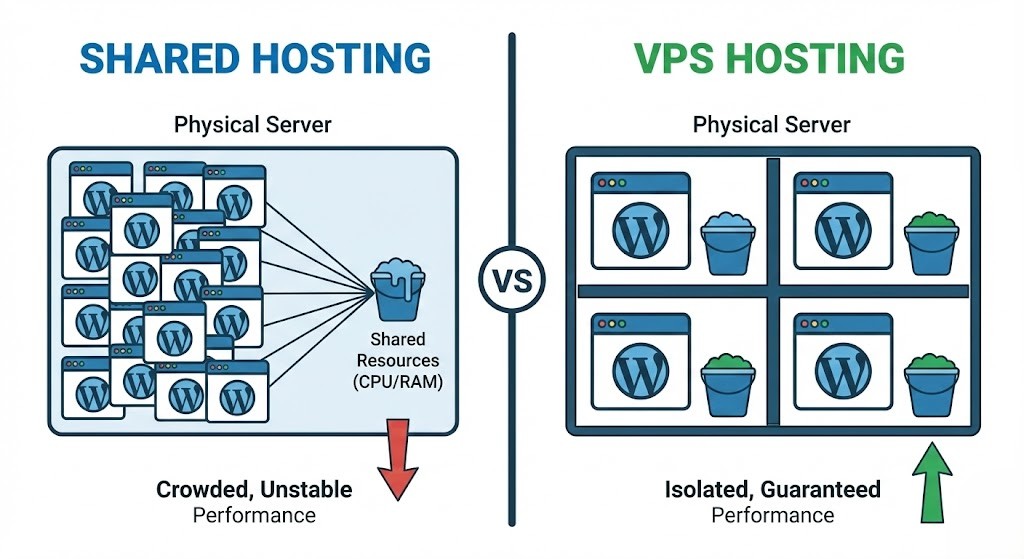
Shared Hosting
Best for:
New business websites
Low to moderate traffic
Tight budgets
Risks:
Performance depends on other users
Limited control
Shared hosting is acceptable only if the provider limits server overcrowding.
VPS Hosting
Best for:
Growing businesses
Online stores
Websites with consistent traffic
Advantages:
Dedicated resources
Better stability
More control
VPS costs more, but often delivers better long-term value.
Common Mistakes Small Businesses Make
Choosing hosting based solely on price
Ignoring renewal costs
Believing “unlimited” claims
Underestimating traffic growth
Neglecting backups
These mistakes lead to forced migrations later, which are costly and disruptive.
How to Choose Affordable and Stable Hosting (Step-by-Step)
Define your website’s purpose and traffic expectations
Choose shared hosting for starting out, VPS for growth
Verify uptime guarantees and real user reviews
Check renewal pricing, not just promo prices
Test customer support before committing
Hosting is infrastructure, not decoration. Treat it as such.
Final Thoughts: Stability Beats Cheap Pricing
For small businesses, the goal is sustainable online presence, not minimal monthly fees.
Affordable hosting that stays online, performs consistently, and scales with growth is far more valuable than the cheapest option available.
If your website supports your business, hosting is not an expense to minimize—it is an investment to optimize.
.jpg)